A preface: The following essay will be detailing almost every major plot revelation in THE BLACK PHONE, as well as that from other well-known films by the same director. I don't personally believe that knowing all the details will ever hurt a first-time viewing of a movie if the story is good and the direction well-executed, and this particular film is less about its surprise revelations and more about how it reaches conclusion, but there is definitely a specific pleasure to be obtained from going into discovering a previously unviewed film with a blank slate. So use that information as you will...
Can you hear what I've been thinking
Do you hear my words out loud
Cause there's an echo that's insisting
That this here phone should ring about now
But when it does, it rings, no questions
Then when it don't, I wonder why
Maybe I'm somewhere you can't reach me
On this dark and lonely night
Writer/director Scott Derrickson has maintained a singular presence in a crowded field of auteurs, by delivering a consistent flow of entertaining films in the horror and fantasy genres, and more importantly, imbuing them with significant themes on and questions about believing in forces other than what's knowable in the corporeal realm. In a business where its most visible talent either cautiously avoid discussing religious practice, or cravenly make it their entire brand at the expense of any nuance, he frequently expounds unvarnished on his life as a Christian, from his conversion to Evangelical fundamentalism in youth, expanding into larger ecumenism in adulthood, and his present of, as he told the National Catholic Register, being more of a general mystic, but carrying a rosary and a G.K. Chesterton book almost all the time. And in full disclosure, I have enjoyed congenial correspondence with the artist for several years, and had the privilege of securing him to introduce one of my series of "Cinema Tremens" screenings in 2014.
There have been two dominant collaborators in Derrickson's filmography, each assisting in getting across ideas that have mattered to him. His first writing partner, Paul Harris Boardman, can be associated with his most overtly Christian-driven narratives - HELLRAISER: INFERNO, THE EXORCISM OF EMILY ROSE, DELIVER US FROM EVIL, while his current writing partner, C. Robert Cargill, has helped steer the more general supernatural tales - SINISTER, DOCTOR STRANGE, and their current hit film, THE BLACK PHONE. Barring the disawowed Pinhead installment (as a certain "SCTV" sketch might say, "Was this box in fact, HELL???"), all these films have conveyed Derrickson's concepts of morality and the varying degrees of what happens when it is compromised.
While he recently stated to writer Walter Chaw, "I haven't made any movies with happy endings. They're always really bleak," in the opinion of this writer, it's not so much that they're unhappy or bleak, but they don't neatly wrap everything in the kind of clean finish that most films...and indeed, some branches of Christianity...often promise; there's a mess to be reckoned with after the credits roll. In the Christian stories written with Boardman, God's glory is served as demon possessions are thwarted, but one priest is found guilty of negligent homicide, a detective causes the death of his partner while his wife and child are traumatized by abduction, and nobody comes back from the netherworld. In the first two outings with Cargill, both protagonists - played by actors made up to bear a striking resemblance to Derrickson - give in to hubris, believing themselves smarter than the unknown forces they're investigating, and while one is completely consumed while the other survives, they both have facilitated the continuation of chaos they thought could be tamed. Sadly, on occasion this conundrum has bled into his real life: as he elaborated to Chaw, two years after the life-changing success of DOCTOR STRANGE, "my house burned down in [the Woodley] wildfire and my wife and I of many years separated and divorced very shortly after that. It was really hard, so hard..."
"[I] thought one day when I was depressed, you know when you’re real depressed and you see everything comes to nothing, well, I thought, maybe I ought to take a different approach, and write [something] that, instead of directed at people, would somehow musically induce God into giving us all a break, cause I was getting a little fed up by this point. So...I’d like to [give this to] you in the hope that you’ll get a break.”
THE BLACK PHONE, Derrickson's newest release, again co-scripted with Robert Cargill from the 2004 short story by Joe Hill, in principle continues exploring his favorite topics - folklore, cruelty, and faith - but takes several new approaches on their depiction. It is his first film that, barring its lead villain, focuses almost entirely on child protagonists. It is his first set in the past, rather than the present tense of his previous stories. There is supernatural activity, but all violence visited upon its characters are acts of free will by humans. And while it is unflinching in its dramatization of family abuse, bullying, psychological torture, and catatonic fear, it is the first Derrickson film that does not leave a mess behind to linger on; God has finally granted the hero a break.
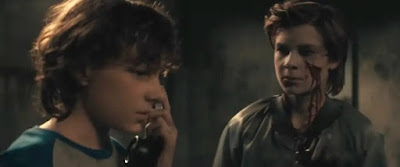
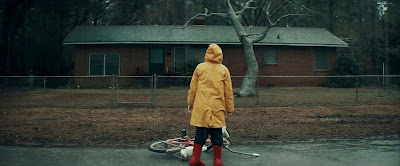
In a Denver suburb during 1978, shy tweener kid Finney Blake (Mason Thames) and his brasher younger sister Gwen (Madeleine McGraw) endure steady beatings from a trio of bullies at school and from their anguished alcoholic father (Jeremy Davies) at home. They have heard accounts of a rumored local child abductor called The Grabber (Ethan Hawke), and his threat looms harder over them when two of Finney's schoolmates go missing. Gwen, in recounting dreams she has had about the kidnappings to others, describes details not disclosed to the public, which leads desperate police to interrogate her while having misgivings about her claims. Finney himself ultimately gets taken by The Grabber, and is imprisoned in a barren, soundproof basement. Already feeling mostly cowed by antagonists, he now faces his ultimate enemy - one who cannot be hidden from, deferred to, bargained with, tricked, or moved - and is almost resigned to the worst. Until an old, otherwise disconnected wall phone, regularly rings just for him, with the voices of previous Grabber victims instructing him on various ways of making an escape. Concurrently, Gwen, unaware of Finney's incidents, senses more details about the crimes, at times almost overlapping visions with him, and sets out to determine if what she's seen is real. But after all Finney's attempts have failed, and he recognizes his captor is ready to finish this grim charade, he'll need to tap into his own spirit rather than the ones beyond him. And Gwen must find order in the chaos of her manifestations - or else. All of these events taking place in a decade where, even today, one of the biggest questions taking place within was whether the children were growing up too fast.
Help me find my proper place
Help me in my weakness
'Cos I'm falling out of grace
- The Velvet Underground, "Jesus"
Going against his previous films whose stories frequently involve long-forgotten arcana about secret societies and deities, there is a brilliant and ruthless simplicity to THE BLACK PHONE in its near-lack of back story. There are references to trauma The Grabber himself was subject to in his childhood, and the suicide of the Blake family's mother when her own powers of prophesy became overwhelming, but they ultimately do not come into play; no digging through dusty books or microfiche, no ancient relics once lost now found. When Finney and Gwen have their flashes to the past moments of the missing boys, witnessing lives they did not otherwise know intimate details about, they are not so much finding clues as they are placing themselves in the shoes of the fallen, building empathy. At the core, this is a straightforward scary tale of survival where each moment matters *right now*, and in many cases, will unexpectedly matter later on. And as all the victims testify to losing memory of their names first, retaining only details of their confinement or their ties to the siblings, it is their job to remember for them to the living world.
Personal memory permeates this film more than perhaps any other Derrickson film and screenplay. Upon first reading Hill's minimalist tale, it became a personal mission for him to adapt it, telling SlashFilm's Jacob Hall, "I had thought about Joe's story for a long time, over 15 years I was trying to do it. And I had given it to my writing partner Cargill, and he loved it too...toward the end of working on the sequel to DOCTOR STRANGE and then stepping off of it, I had been in therapy for three years dealing with the traumatic nature of my own childhood, and just the violence that I experienced, and violence in my home and my neighborhood, the bullying, just the kind of place that I grew up. And I felt that I could take all of that and merge it with Joe's story, and have something really powerful. [The] most terrifying difficult scene to watch in the movie is the whipping, and that happened to me all the time as a kid, and a lot of other kids in my neighborhood. That was pretty standard for that time, for the late '70s. And so the idea, ultimately, of making a movie about childhood trauma and the resilience of children became — it's a horror film and a coming-of-age film."
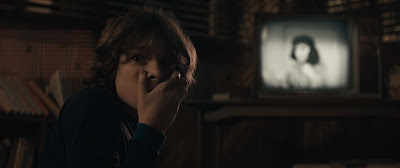
Lest these details make the film sound unbearably grim, there is a frequent and therapeutic amount of levity throughout the story. There is warm and funny banter between the siblings and their friends, discussing such solemn topics as toughest kid in school rankings, who's the best TV heartthrob, or the better "forbidden" adult action movie to sneak a look at. Totems of the 70s are used sparingly but smartly, with darkly humorous moments as Finney watching William Castle's THE TINGLER (specifically, the scene when a mute woman is attacked by the creature, telegraphing his own impending imprisonment of silence), or when Robin's abduction is followed by a TV screen broadcasting "EMERGENCY!" And most surprisingly, Gwen's relationship to religion provides the most laughs, as she has clearly not had any actual church upbringing and is cobbling together her own ritual to speak to Jesus; when she feels she's been left adrift by God, whilst not descending to the rage of, say, Harvey Keitel in BAD LIEUTENANT, she has no qualms about expressing herself to the Great Infinite with several expletives...though she quickly apologizes just in case. Our heroes are dealing with ordeals on par with Job himself, but never lose their capacity for rueful amusement.

As befitting its period setting, in the best ways possible, THE BLACK PHONE unfolds and plays like a tight, efficient ABC Movie of the Week that its 1978 characters would be at home watching tonight. If Derrickson & Cargill's script had somehow traveled back in time to Fred Silverman's desk, it would have easily become a World Television Premiere directed by Curtis Harrington, starring Alfred Lutter, Quinn Cummings, and Richard Thomas as The Grabber. The premise of isolation and escape with a ticking clock amidst an outwardly uncaring world calls to mind not just horror classics as Jack Smight's 1972 THE SCREAMING WOMAN with Olivia de Havilland and THE LONGEST NIGHT with James Farentino, but even non-horror fare as Daryl Duke's 1975 A CRY FOR HELP, written by future "MURDER SHE WROTE" co-creator Peter S. Fischer, where Robert Culp plays a morning "shock jock" talk radio star who, after initially ridiculing a suicidal caller, changes course and desperately appeals to all his listeners to help track her down before she gives in to her depression. (All films produced, appropriately enough, by the studio behind this one, Universal.) In one powerful moment, Culp's DJ could just as easily be speaking for Gwen after her brother's kidnapping:
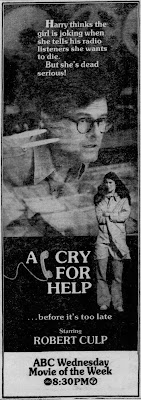
"There's a guy down at the police station - you heard him - who said that the girl can't be found. The word was can't. Well, I'll tell you what I think. Maybe we better get cracking. Not just me, but all of us, because...I guess she's one of us...and maybe we oughta take some responsibility for her."
Hey, now, who really cares?
Hey, won't somebody listen
Let me say what's been on my mind
Can I bring it out to you
I need someone to talk to
And no one else will spare me the time
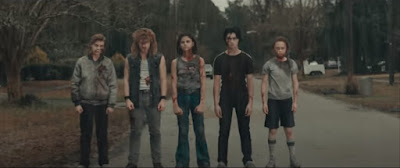
Indeed, the notion of being the proverbial brother's keeper is the recurrent thread through Finney's interactions with the voices of The Grabber's previous victims, all of whom, in their own ways, are children on the margins. Bruce Yasmada is Asian, Robin Arellano is Latino, mingling amiably with white kids in a time where racial integration in the suburbs is still a relatively new phenomenon. Billy Showalter, who bristles at hearing his name and prefers being called by his occupation "Paperboy," suggests a child thrust into the work force to sustain the household. Griffin Staggs is a proverbial lonely invisible kid - Finney says to him, "I didn't know you," and he replies, "Nobody did." And Vance Hopper, by contrast, is one of the meanest, most feared people in the neighborhood, almost a rival to The Grabber in tall tales around the playground, the kind of person who would actively not be missed. They have little in common beyond any of them not being considered one of the average boys in town, but in cold Kubrickian calculus, whatever their previous quarrels, they are all equal now. And in turn, it is now Finney's task to try every strategy they offer him to escape and expose their killer. He has already demonstrated an ability to grasp the circumstances of others, it is time to augment that with action. Because, as Robin reminds him, he is capable of withstanding pain without compromising his morals: "You were always afraid to throw a punch, but you knew how to take one." When he was alive, he warned him that some day he would have to stand up for himself, and in his posthumous counsel he proclaims, "Someday is today...Use what we gave you." In saving himself, he will also make sure the other boys are not forgotten, and that no other child in their town will be claimed either.
This is a sentiment that is right at home in the tradition of Roman Catholicism what has fascinated Derrickson for some time. Though almost completely eliminated in the present day, for centuries during the Sacrament of Confirmation, when a teenager stands before an archbishop and speaks for themselves the vows that a godparent previously took for them at Baptism, the bishop would in turn softly touch their cheek with their hand, to symbolize the potential conflicts ahead from adhering to those vows. And while post-Vatican II church teachings have attempted to de-escalate the fetishization of suffering, many Catholics, including myself, appreciate the base concept that in life, doing the right thing is often going to hurt, emotionally and physically, and many times, it will be an unrewarding endeavor. Finney gets a taste of this harsh truth when, upon trying to thank Vance for his escape hint, he screams back, "IT'S NOT ABOUT YOU, FUCKHEAD!" In his literal quest for survival, he accepts a crucial lesson about allyship, that some of the pain of conscientious behavior will involve being castigated by the very souls he seeks to help. With apologies to Eddie Izzard, being good won't guarantee you any fucking cake; at best, maybe a cracker on Sunday.
You've been sitting on your ass
Trying to find some grace
But you better save yourself
If you wanna see his face
Derrickson, in his thoughtful interview with Chaw, expounded on the acceptance of pain in a life of faith, as opposed to the excessive positivity of, say, Prosperity Gospel purveyors. He states, "man, in that culture, you gotta be happy. You gotta be happy and everything's positive because that's the result of loving Jesus. That's proof. You wanna hear the Good News? Everything's great. You know, He saved me. Never mind the horrible and obvious shit I have pressed down into my gut, my life is wonderful. Everything is great. The idea of delving into darkness is in the Catholic tradition, but boy, it sure as shit is not in the Evangelical one. That's not healthy. It has no relationship with reality. There's kind of a no darkness allowed rule when it comes to that brand of American Christianity."
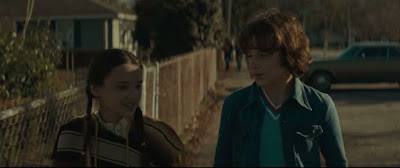
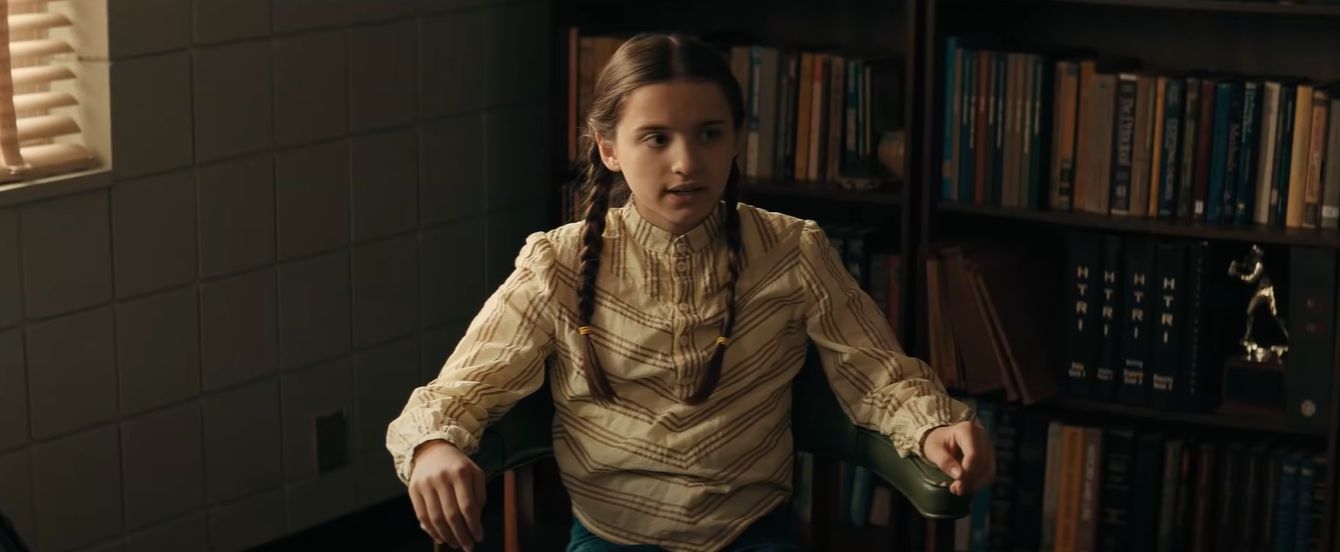
As Finney is the surrogate for Derrickson learning to transcend childhood trauma, Gwen is the surrogate for accepting mystery in the greater world. She is initially trepidatious at the prospect of psychic sight, having only a vague knowledge that her mother claimed to be able to "see things" before taking her own life, much like Ellie Taylor, the tender protagonist of Edgar Wright's equally scintillating 2021 thriller LAST NIGHT IN SOHO; to her, this gift has only yielded alternating bouts of abuse and angst from her father. But once her own brother goes missing, with practically all the adults around her proving to be nigh worthless for help, she's open to accept whatever God or her subconscious have to show her. She's wise enough to temper these mind flights within the reality of her environment, lest this become a Great Pumpkin-esque weight on her playground reputation, but as she bravely and alone follows the crumbs, she helps make a positive outcome possible; she's is willing to look where others have not thought to look, be it in that quiet house no is seen entering or leaving, or in her own self.
Reflecting back on Derrickson's assertion about his previous endings, any viewer will concur that this is the cleanest and happiest resolution of his films. In sober terms, it's not without some future ambiguities for its characters. Finney likely may find himself overcome by survivor's guilt as he grows older. His Big Man on Campus status will dissipate one day, and his old antagonists may feel bold enough to resume stirring his pot. He and Gwen may be in a honeymoon stage with their father now that they've emerged from this ordeal safe, but how long before a parental hand gets raised in a fit of pique again? But these matters will be dealt with later, if or when they happen. Today, *right now*, he has earned the right to express his wish to be called "Finn," and to be exempt from petty shit. He now has faith in his abilities to survive and assert himself. Gwen now has faith that the world has forces that will set things right. And these already loving siblings have blood proof they can rely on each other. Tonight, they're going to stay up past their bedtime, watch scary movies and eat ice cream, and enjoy childhood.
Help your fellow man
Your cause is great and good
Your temple made of sand
No trace of where it stood
No, you can't be hurt
You're a golden child of God


 I can talk about a smaller but respectively awesome event: after lobbying what seemed in vain for over a decade, I was able to witness my valued friend Philippe Mora saw his wonderfully eccentric and earnest 1983 film THE RETURN OF CAPTAIN INVINCIBLE - a film I've gone to the mat for going two decades - get the bells-and-whistles Blu-Ray edition it's deserved. And I had the honor of conducting a long-form, full-career interview with him that is among the bonus features on this release. I relish any opportunity to speak for posterity on physical media, and I've long wanted to contribute to the legacy of tremendous presentations that the Severin label is known for.
 When it often seemed like every physical media label had their own in-house version of me already to work on their special features, Bill Olsen gave me opportunity when nobody else wanted me, and I owe him. I've had a long, wild history with him and his Code Red Blu/DVD label, involving a lot of loud late night phone calls, effectively begging for his cinematic scraps to build my exposure, and having to helplessly watch him try to burn every bridge in the home video business. But as Harlan Ellison once observed, when you've been made an outcast, you are always angry. And Bill was, well, mostly known for his outbursts, living his life like a spite house. We would yell at each other, and a minute later be laughing at old inside jokes. He didn't have a lot of friends, so the fact that I kept his trust and he mostly had my back was important to us both. And as I got what precious few insights I could into his background, I think the only reciprocated love he ever had in his life was with the movies.


















 Posts
Posts

