Tuesday, April 27, 2010

Make Me a Vessel of Your Peas

Contrary to what Marc Antony opined, it is not just the evil that men do that lives after them, it is also the inanity. And just as often as we discuss the great performances of our favorite entertainers, we are likely to discuss their blunders, especially if they were not meant to be made public. And in a bizarrely appropriate parallel, just as he made arguably the most influential movie ever made, Orson Welles also made the best-known tantrum ever recorded on tape. If you are not familiar with this Great Moment of Histeria, WFMU-TV creator Mark Rudolph directed and starred in this reenactment film back in the mid-'90's:


In an era before the internet and hyperactive tabloid activity, when incidents of bigwigs behaving badly could be kept quiet, somehow the word got out that if you could prove emphasizing a preposition at the front of a sentence was grammatically acceptable, you too could win a hummer from the man who panicked America. And many of those listeners happened to be entertainers, who proceeded to integrate snippets and aspects of this into their own work, and didn't care whether anyone else would get the reference.

By now, the most widely known homage to the tape is of course the beloved animated TV series "PINKY AND THE BRAIN." While the appearance and dynamic of two laboratory mice attempting to conquer the world was already conceived by the creators of its parent program "ANIMANIACS," it was voice artist Maurice LaMarche who conceived the notion of giving Brain what he described as "65% Orson Welles, 35% Vincent Price." I am convinced that once this concept was applied, co-star Rob Paulsen then made the decision to give Pinky his exaggerated cockney accent, as the voice of the beleaguered director of the ill-fated Findus commercials is clearly some sort of British origin. The series would carry on this inside joke to its logical extreme: in "Yes, Always," a segment originally intended as an exclusive to a VHS compilation but later broadcast on television, the entire incident (along with a shorter one with the same director) was restaged almost word for word, with the invitation to oral sex replaced by a more kid-friendly offer to manufacture cheese. Consequently, hundreds of children and hip parents who knew nothing of Welles or his perfectionism were now eagerly quoting his outbursts for quick laughs.

What is hardly ever discussed is the fact that in their own way, one of the greatest teams in comedy also paid their respects to this incident. On the absolutely-truthful MONTY PYTHON'S CONTRACTUAL OBLIGATION ALBUM, there is a sketch simply called "Bishop," which involves the already strange (but by Python standards, par for the course) situation of an Anglican bishop attempting to deliver voiceover narration for a beer commercial. To add to the randomness of the setting, the bishop feels a strange compulsion to repeatedly describe the beer as tasting of fish. After flubbing multiple takes, the engineers decide to just manually edit out the fish material rather than keep taking up the bishop's time. They tell him to take five and the sound men talk amongst themselves:

 
Idle: Who is he?
Chapman: The Bishop of Leicester, I think.
Idle: Well, why couldn't we get Bath and Wells?
Chapman: He's doing frozen peas for Nigel.
Idle: Lucky bastard. He's so good.

Again, there has never been any acknowledgement from the Python camp that there was any outside inspiration for the sketch. Besides, Bath and Wells is an actual diocese in England, and there's no second 'e' in the word there. But the three-strike combination of 1) a British commercial voiceover session gone wrong; 2) the preference for "Well(e)s" because he's supposedly a better narrator; and 3) the specific mention of "frozen peas," which is the title that Welles' recording had been circulating under back then (and still, according to Wikipedia) suggests to me that the troupe were fans of this tape. They may not have been prone to do many insular jokes, Reginald Maudling bashing notwithstanding, but this is surely one of them. And this theory of mine, which belongs to me, that is the theory that I have, and which is mine, and what it is too.

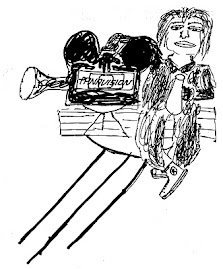
Welles himself was aware of how far and wide the tape had traveled, and that many of his peers were probably joking about it behind his back. Outside of one mention of it during the recording of his swansong role as Unicron in the original animated TRANSFORMERS movie (where he agreed it was not his finest hour but stood his ground that his director was a graduate of the Columbia School of Dipshit Broadcasting), there seems to be no documentation of his feelings about the tape's emergence. My personal guess is that while he was certainly not pleased about the leak, he'd been on the dais for enough Dean Martin Roasts to be able to chin up and get the piss taken out of him. And in some ways, especially had he lived to see "PINKY AND THE BRAIN," the ribald joker in him who regularly parodied his persona on "I LOVE LUCY" and "LAUGH-IN," and was not above donning corny disguises and accents to get a laugh, probably would have thought it was hilarious. 

 I'll have to stop here. I think I just heard a gonk.

Friday, April 23, 2010

What Savings!

Erudite horror blogger and "Kill Face" kronicler Arbogast On Film struck a nerve among fellow mavens with a long-tail blog-a-thon he launched a couple years ago, The One You Might Have Saved: a meme dedicated to character deaths in films which, no matter how much one appreciates them in the narrative of the story, affect us so personally that we would cross Fountain darling and Syd Field to save their lives. A few days ago, he renewed the call for submissions, and since I am the baby in the blogosphere, I'm answering the request, although my choice is not quite from a horror film, though it's certainly in the neighborhood suggested by the topic.


Jack Hill's SWITCHBLADE SISTERS was one of my earliest and still most potent experiences in exploitation film viewing, and I have prescribed it time and again for all manner of first-time viewers. Three decades after its release it still takes people by the throat - in the course of hunting down images, I found blog accounts from three first timers who were writing about these bad girls with cold steel with the same thrill of discovery that I felt upon my first viewing. So I don't tread into this decision lightly. I know that to suggest any alteration to what is one of the near-perfect drive-in dramas is to dance with heresy. And since the film rather cleverly restages Shakespeare's OTHELLO in '70's denim, what I am about to say is both figurative and literal bowdlerism. But in my movie universe, Jezebels elder Lace would receive my Get Out of Death free card.


Make no mistake, I would not want to cross paths with Lace, at least not during most moments of her life as depicted on film. Like the trailer announcer Ron Gans says, she's as affectionate as a scorpion with all the loving tenderness of a buzzsaw. But the more time we spend with her, the more she becomes fully realized and human. When we first meet her, she's witnessing her mother getting shaken down by the rent-to-own man, choosing to spend the rent and food money to keep the TV; when minutes later Lace has her girls buttonhole (and buttonrip) the bagman to get the cash back, he may be the law-abiding citizen and them the dangerous thugs, but we don't exactly feel sorry for him. And over the course of the film, it only gets worse for Lace. Her loyalty to the Daggers gang heartthrob Dominic is rewarded by him date-raping her new best friend Maggie while she's in juvie, and lying to her face about it. When she discovers she's pregnant and considers going straight and settling down with her man, he throws some $20s at her and tells her to get an abortion. And all the while her Iagoesque lieutenant Patch is manipulating her into making one bad decision after another. And in the film's greatest stroke of tragedy, as the gang she nurtured from mere ornaments to full-on baaadassssses should be enjoying their dominance over the city, Lace is goaded again by Patch to challenge, and ultimately die at the hands and blade of, Maggie, the only person who truly loved her.


In short, Lace never stood a chance. The white man ain't left her nothing out here but the underworld, and that's where she dances...where do you dance? Jack Hill is not the first person to observe that women could rule the world if they would only stop hating each other, but he's one of the best at depicting how much is lost in such circumstance.


To indulge my fantasy and still respect the harsh universe that Hill created, Maggie's knife would have still done enormous damage to Lace, enough to leave her unconscious and good as dead as the cops bust in and haul away all but the treacherous Patch as the film depicts. And then days, maybe weeks later, as Maggie cools her heels in stir, she gets a visit from a solemn Lace. It's hardly a happy reunion - at first all they discuss is business. We learn Patch tipped off the cops to raid their rumble, planning for Lace to kill Maggie and get pinched, allowing her to take control of the gang. But instead, without the Jezebels to protect her, she herself has been killed by leftover members of the Daggers, who hold her responsible for the roller-rink deaths that in fact Lace inadvertently caused in her first attempt to kill Maggie. Nonetheless, Lace knows she's finished with thug life and confides in Maggie she's skipping out on her family and the city in the hopes of starting over. Maggie figures out that it also means she won't be present to testify in her attempted murder trial, giving her hope of beating the charge. The closest they come to making up is Maggie mutters that she is sorry she tried to kill her, and Lace replies she is sorry she made her have to.

And as she exits the prison into a landscape that is just as grimy as before, the girl who literally grit her teeth to keep on surviving in a dog-eat-bitch world, gets to survive a little longer.

Saturday, April 17, 2010

Push the button, Marc

From the moment I joined the intarwebs commewnitty, I've been an easy mark (pun fully intended) for a good survey/questionnaire meme. And Dennis Cozzalio, proprietor of the excellent Sergio Leone and the Infield Fly Rule blog, has apparently joined forces with other correspondents in the service of legendary scoundrel Professor Fate for a heavy duty spring movie quizz. As that Professor demands satisfaction, I offer rejoinder in the paraphrased words of that other great mad Professor, Julius Sumner Miller: This, flicks, is my business!

1) William Demarest or Broderick Crawford?

Amist all the over-the-top insanity of IT'S A MAD, MAD, MAD, MAD, WORLD, one small moment of palpable hearbreak and audience sympathy occurs, and it's when William Demarest reluctantly proclaims, "Attention all units: arrest Captain Culpepper."

2) What movies improve when seen in a state of altered consciousness? (Patrick Robbins)

Well, I will admit that I was baked like Alaska when I watched last year's LAND OF THE LOST, and consequently gave it a three-star assessment.

3) Favorite studio or production company logo?

United Artists, post-Transamerica, 1981:


Many a night of falling asleep with the TV on was interrupted by this sneaky intro.

4) Celeste Holm or Joan Blondell?

"The cynicism you refer to, I acquired the day I discovered I was different from little boys!"

5) What is the most overrated "classic" film? (Tony Dayoub)

THE MATRIX. A movie that purports to take place in an environment where any and all things are possible, and the climactic battles are still fought with guns?

6) What movie do you know for sure you saw, but have no memory of seeing? (Patricia Yokoe Cozzalio)

Back in the glory days of pre-Fox network WXIX-19 in Cincinnati, there most have been dozens of afternoon movies that I watched with the faintest of attention. If I could summon up one, probably John Berry's CLAUDINE with Diahann Carroll and James Earl Jones; all I remember is the announcer's i.d. breaks during the broadcast.

7) Favorite Hammer Film?

KISS OF THE VAMPIRE

8) Gregory Itzin or Joe Pantoliano?

Gotta have pants. Joey Pants!

9) Create a double feature with two different movies with the same title. No remakes. (Peter Nellhaus)

How about a triple feature of Paul Morrissey's HEAT (1972) with Joe Dallesandro, Dick Richards' HEAT (1986) with Burt Reynolds, and Michael Mann's HEAT (1985) with DeNiro and Pacino.

10) Akiko Wakabayashi or Mie Hama? (Ray Young)

Umm...Abraham Lincoln?

11) Can you think of a (non-porn) movie that informed you of the existence of a sexual act you had not known of prior? (Bob Westal)

I think I recognized Troy McClure's paraphilia in such movies as STROKER BASS and EVERYBODY'S FIN.

12) Can you think of a black & white movie that might actually improve if it was in color? (Patrick Robbins)

I recall seeing some bizarre colorized footage from Bunuel's UN CHIEN ANDALOU that was in keeping with the already dadaesque visuals; I would enjoy seeing the whole thing done up in similarly off-the-sprockets fashion.

13) Favorite Pedro Almodovar Film?

ALL ABOUT MY MOTHER. The apex of his gift for comedy, tragedy, colorful women, troubled men, and a world that can be painful, but ultimately works for the better.

14) Kurt Raab or Udo Kier?

Who da man? Udo man!

15) Worst main title song (Peter Nellhaus)

While Eric Serra's instrumental theme for LA FEMME NIKITA is awesome, whoever suggested that he and Luc Besson should add English lyrics to it for the closing credits ("The Dark Side of Time") should be buried in Row 34, Plot 12.

16) Last movie you saw in a theater? On DVD, Blu-ray or other interesting location/format?

Theatre: Robert Flaxman and Daniel Goldman's 1976 documentary A LABOR OF LOVE;
DVD: Michael Winner's PARTING SHOTS
VHS: Harvey Hart's THE PYX.

17) Favorite movie reference within a Woody Allen movie? (Larry Aydlette)

The constant allusions to THE SORROW AND THE PITY in ANNIE HALL. Reminds me of how my longtime roommate and I were almost forcing everyone we knew to watch HOOP DREAMS.

18) Mary Astor or Claudette Colbert?

Ask Roy Orbison.

19) Favorite trailer (provide YouTube link if possible)?

Jean-Luc Godard's CONTEMPT (LE MEPRIS):


Possibly the greatest trailer ever made.

20) Oddest double bill you either saw or saw listed in a theater

There was that Harlan Ellison-curated New Beverly double feature of Kurosawa's STRAY DOG with Cimino's THUNDERBOLT AND LIGHTFOOT.

21) Favoite Phil Karlson film?

HORNETS' NEST. People are upset about one little girl wreaking mayhem in KICK-ASS? How about Rock Hudson teaching a whole village of orphans to kill?

22) Favorite “social problem” picture?

I suppose HOOP DREAMS, because it suggests without preaching that such problems, with steely determination, can be overcome.

23) Your favourite Harryhausen film/monster? (Ali Arikan)

My first striking Harryhausen memory is the snake woman from THE SEVENTH VOYAGE OF SINBAD, but I think I'd have to go with THE BEAST FROM 20,000 FATHOMS, because as Ray Bradbury put it, he was really just a poor brute who fell in love with a foghorn.

24) What was the first movie you saw with your significant other? (Patrick Robbins)

I've been unattached for far too long; thanks for reminding me, Prof. ;(

25) John Payne or Ronald Reagan?

Well...

26) Movie you feel a certain pressure or obligation to see that you have not yet actually seen

There are so many gaps in my classics it's shameful. But I think the two that keep haunting me the most are SINGIN' IN THE RAIN and THE TREASURE OF THE SIERRA MADRE.

27) Favorite “psychedelic” movie (Hey, man, like, define it however you want, man…)

It's not a good movie in any way, but I'm fond of Robert Freeman's THE TOUCHABLES as psychedelia, because it does feel like the crew mixed up the wrong chemicals during a Harold sketch and put the whole thing on film. And really, being in a big bubble house as the captive of hot '60's chicks is awful groovy, man.

28) Thelma Ritter or Eve Arden?

"Nothing has caused the human race so much trouble as intelligence."

29) Favorite iconic shot or image from a film?


Whether you believe like me that it is a grim reminder that when you leave a place of magic you can never return, or believe like others that it is a glimmer of hope, that solitary ringing in that lonely phone box at the end of LOCAL HERO gets me every time.

30) What is the movie that inspired the most memorable argument you ever had about a movie?

My longest relationship was marred when she insisted on turning off LOCAL HERO an hour in because she was bored. I did not take that appraisal very well. Not the primary reason that the relationship didn't work out, but it was a contributing factor.

31) Raquel Torres or Lupe Velez?


You know what? Lina Romay makes me happy.

32) Favorite adaptation of Shakespeare to a film?

Kenneth Branagh's HAMLET, the GONE WITH THE WIND of Shakespeare adaptations. It seems almost every previous film of HAMLET felt locked into the dialogue scenes, but Branagh understood that a movie can show anything it wants. So in a brilliant stroke, he presents every line of the play while depicting details barely hinted at - Hamlet and Ophelia in passionate privacy, Fortinbras plotting his return to the throne, the size of the armies, etc - and does it in gleaming bright 70mm. The staging of the "My thoughts be bloody" monologue manages to even upstage "To be or not to be" as the best speech in the play, and is as perfect an emotional harbinger and intermission marker as Scarlett O'Hara's "I shall never go hungry again!" What is arguably the greatest English-language play was long overdue for this epic film treatment.

33) Andy Warhol’s Frankenstein (in 3D)-- yes or no?

YES! It still galls me that I missed it in childhood and had to wait until my 30's to see it in all it's organ-hovering glory.

34) Favorite movie rating?

I stand with Strong Bad in my love of the ultra-rare triple-R rating.

Which reminds me, I know Don May at Synapse Films reads this blog, so hey man, why haven't you licensed WOMEN'S PENITENTIARY BAKESALE NIGHTMARE yet???


35) Olivia Barash or Joyce Hyser?

Any woman who can make herself so mannish as to inspire babydyke fantasies for two generations, and both bag and dump Warren Beatty, has got a gift. Joyce Hyser for the win.

36) What was the movie that convinced you your favorite movie genre was your favorite movie genre?

Probably that first time I saw IT'S A MAD MAD MAD MAD WORLD on CBS, New Year's Eve, with my parents. My childhood head recalls them saying how they'd seen it in New York City during their short sojourn living there before I was born. Watching them still laughing at it, and how many times I was laughing at it, convinced me that comedy was the greatest thing ever.

37) Favorite Blake Edwards movie?

THE PARTY.

Thursday, April 8, 2010

"I know you can change the weather"

I have just learned from fellow blogger BookSteve that performer, entrepreneur, and all-around provocateur Malcolm McLaren has died. McLaren's passing is especially ironic to me right now as I had literally been contemplating writing my next piece about what is probably his finest work and for me, my "desert island" album. Coming less than a month after the untimely passing of Alex Chilton, it is an enormous blow to me as a fan of both men, as they had enormous impact on my musical taste.


The obituaries you will read on McLaren will be colorful and varied. Some will discuss his early collaborations with fashionista Vivienne Westwood. Most will focus on his infamous (and some would say deliberate) mishandling of punk rock pioneers the Sex Pistols, and let us not indulge in hagiography: between the lying and posturing and enabling, which contributed not only to the band's untimely demise but also to the ugly deaths of bassist Sid Vicious and his girlfriend Nancy Spungeon, he'll be smoking a turd in Purgatory for quite some time. But in all likelihood, not that many will address his groundbreaking and exciting album, DUCK ROCK, though thankfully, PopMatters seems to share my enthusiasm. As such, what was going to be just a musical puff piece on my part will effectively turn into a memoriam.

DUCK ROCK was initiated by McLaren shortly after the breakup of the Sex Pistols, as he began to be more interested in being in front of the cameras and the microphone instead of managing from the sidelines. With producer Trevor Horn in tow, they went on a worldwide journey visiting and recording all manner of diverse musicians, from South Africa and the Caribbean to Appalachia and New York City, and after they were done, mixing and mashing up the sounds to create surprising combinations. McLaren was not much of a singer, more of a spoken-word carny barker, but his sense of fun as he traveled through the genres was hard to resist. 

I first learned about DUCK ROCK from rock journalist Lisa Robinson, during a series of promotional interviews she conducted with Malcolm McLaren for the USA Network series "RADIO 1990". Interspersed with the interviews, which covered topics like the breakup of the Sex Pistols and the countries he visited, there were music videos shown. Most specifically, the video for "Buffalo Gals," a still-exciting traffic jam of sampling, d.j. scratches, and old fashioned square-dance calling. For a suburban Cincinnati boy like me who was eager to break from the bland, it was a clarion call. And for decades since, artists like Neneh Cherry and Eminem have replayed it in their own fashion:


Once I got the album (or in my case, Island's unusual "1+1" cassette tape which presented the entire record on both sides), it was a constant presence in my boom box. I loved getting exposed to world music without the stuffy high-toned culturespeak of public radio snobs, and it didn't matter if friends didn't quite understand what I meant when I occasionally shouted "Skip-day-doo, the double dutch," "Zulus on a time bomb," or "Duck for the oyster!" To this day, I still love going on the global tour. For as much as we talk about living in a society that is supposed to resemble a Benneton advertisement, so much about the places we don't know is presented to us in a dry and somewhat "eat your vegetables" fashion, which is why so many of us resent it and don't investigate it. As much as people love Peter Gabriel or David Byrne, they get annoyed at their earnest effort to expose music from elsewhere and don't give a damn about their next WOMAD concert. And don't get me started on how much I hate the "granola rock" of poseurs like Rusted Root. Somehow, McLaren never gave that vibe in DUCK ROCK - the album always said to me, "Hey, it's a big, exciting, beautiful world out there: let's go play!" 

In the liner notes, McLaren writes that during his time with a band of South African musicians, as he sat among them at a campfire, they told grand adventure tales, and he was asked to share one of his own, and all he could think of was his version of managing the Sex Pistols. His hosts loved the story, and out of that came one of my favorite tracks, "Punk it Up," where tribal people who have never experienced slam dancing or Margaret Thatcher gleefully sing, "I'm a Sex Pistol, I'm a Sex Pistol, that's what I am!" Maybe they understood the notion of being in a group that wanted to fight the man, or maybe they just fell for a good yarn. But everyone has a happy sing-a-long all the same. 

And ultimately, we look to a great artist to take us to another place, even if they are spicing it up with details that are of their own invention and may clash with our own view of things. Malcolm McLaren did that for me. Even John Lydon, a/k/a Johnny Rotten, the man who would have every reason to sneer and spit and dance a pogo on his grave, understands that notion in his gracious send-off: 

"For me Malc was always entertaining, and I hope you remember that. Above all else he was an entertainer and I will miss him, and so should you." 

Thanks for the grand adventure, Malc. May your coffin be circled by Buffalo Gals going 'round the outside, 'round the outside, 'round the outside.

Wednesday, March 31, 2010

'tis a Vile and Thankless Task

Back in my stand-up days, a fellow comic named Faye Haire had a series of "Your mommma is such a dumb hooker..." jokes I was very fond of. The biggest laugh of the batch was for, "Your momma is such a dumb hooker, she forgets to collect her pay, which means she's just a slut!". Too often, that is exactly what it feels like to be me in this showness we call biz. In the elusive and vain hope of getting visibility and recognition and perhaps that great mythical second cup of coffee, plenty of us know-it-all movie snots do all manner of unpaid work. Not just blogs like these, obviously, but book forewords, screening intros, and especially DVD commentaries. In our heads, we are thinking why, if Gloria Stuart could get cast in TITANIC after her wonderful repartee with Bill Condon and Curtis Harrington on the laserdisc of THE OLD DARK HOUSE, surely one of us thriftstore Eberts could get heard on some low-budget Z-movie release and be hired by one of the big eight to wax eloquently on one of their silver platters, right? WORNG! But we do it anyway. What can I say? While Faye's joke is appropriate, I guess my name is Heuck and I like to feuck.

Now, I have built up a small reputation for being a good talking voice on the genre DVDs. I have also built a reputation for being willing to take on assignments that none of the more respectable moderators in the business would accept. As such, this is why I actively discourage people from labeling me a movie critic or trying to classify this blog as any kind of scholarly journalism. I will freely own up to the fact that I have done commentaries for movies that I know in my heart are irredeemable crap. More importantly, I will own up to the fact that I want people to buy and watch them, both to bear witness to my hard work, and to make money for the companies who hire me so that they will be inclined to hire me again...and maybe next time pay me something.

To be clear, it's not unpleasant to do special features for a bad movie. In fact, it's often fun depending on the demeanor of the participants. When I was enlisted to moderate commentary for the previously unreleased (for good reason) horror comedy NIGHT OF THE DRIBBLER, it gave me the pleasure of trading goofy impressions and corny jokes with veteran comedian Fred Travalena, and it was a thrill to go round-to-round and hold my own with him. In retrospect, as none of us at that recording session were aware of his ongoing fight with non-Hodgkins lymphoma which would ultimately claim his life four months later, I was darned lucky and privileged to have my role in what would be one of his last public speaking events. Yeah, in all candor, the movie is about as funny as a hangnail, but if you listen to my commentary, you'll find yourself laughing for all the right reasons.


And then, there's commentaries like the one I did for this better-forgotten horror film from 1981, SCREAM. The director, Byron Quisenberry, was a nice and sincere enough fella, but darn it if he wasn't dryer than dust in a lumberyard. If you're willing to laugh for all the wrong reasons, listen to me extend to him every possible interpretation of his film, its L.A.-rush-hour-slow pacing, and its near-incomprehensible resolutions, that would exonerate him and justify the artistic decisions (or lack thereof) that have been mercilessly ridiculed by almost every IMDb reviewer and blogger that endured this snorefest...and listen to him just repeat the mantra, "Eh, it is what it is." I mean, I can't be that asshole who rips the movie to shreds in his presence, but when he all but admits on mic that he made the thing because he could get the Paramount Ranch cheap for a week and call in favors from a bunch of old actors, and that he barely had a script, and that it's a miracle it turned a profit in theatrical release, any normal person would crack from the intransigence and call him out. But I'm not a normal person. So if you've ever thought James Lipton was a fawning blower of smoke, listen to this commentary and you'll think I'm Union Fucking Carbide! Then again, if I can make this abuse of guitar picks look like more than "what it is," imagine what I can do for your movie. So how about giving me a gig? A paying one?


Oh yeah, and meanwhile, buy the DVD! Use the $18 you were gonna spend on CLASH OF THE TITANS this weekend; if necessary, tell your brats they can watch the old Harryhausen version and deal with it. And if they keep bellyaching, make them watch SCREAM with you; once it's over, they'll know never to disrespect your authoritah again!

Tuesday, March 30, 2010

Posthaste and Posthumous

There is something irresistable about the notion of finding and viewing a "lost" film, though nowadays the label gets bandied about so often as to carry no heft. What constitutes "lost" anymore? To some, it means that the film has always been around, just ignored upon it's first release. To others, it implies an unavailability that has been rectified. And really, you could say if you've never heard of it, it's "lost" to you. Nonetheless, part of the reason for this circumstance is because that damned adjective always gets your attention. And when it is properly applied to the category of a film that has never had any public screening previously, it works every single time, beckoning both casual viewer and hardcore cinemaniac alike. It's been the basis of novels like Tim Lucas' excellent THROAT SPROCKETS, and movies both acclaimed like BROKEN EMBRACES or infamous like CANNIBAL HOLOCAUST. There's inherent drama in the reality even if the finished product itself disappoints: a troubled production, a stolen negative, a warehouse fire, a worldwide hard target search - it's like getting two narratives for the price of one. And while we wait still for Peter Bogdonavich's promised reconstruction of Orson Welles' THE OTHER SIDE OF THE WIND, and as Jerry Lewis will likely have the footage from THE DAY THE CLOWN CRIED buried with him in Forest Lawn, I and other Los Angeles film fanatics have recently been able to finally view two productions that had been on the proverbial milk carton of Hollywood for decades, and with the help of progressive film bookers, they could appear in your city as well. While they couldn't be more different in terms of subject matter or target audience, they are united in their auteur's singular focus and devotion. And, sadly, the fact that neither of them are with us to enjoy their emergence.

Duke Mitchell would have already merited a decent-sized paragraph in Hollywood history solely through his short-lived teaming with comic Sammy Petrillo, which resulted in the infamous B&W quickie BELA LUGOSI MEETS A BROOKLYN GORILLA and the apparently lifelong ire of Jerry Lewis, and for providing the singing voice for Fred Flintstone in multiple episodes of "THE FLINTSTONES" (one which initally featured the fingers-drawing-a-square gag repeated by Uma Thurman in PULP FICTION). But after seeing Francis Coppola's THE GODFATHER, and influenced by years of performing in nightclubs with criminal influence behind them, he decided to one-up the presiding Italian-American filmmaking hyphenate and single-handedly produce, write, direct, and star in a cheaper, shorter, punchier, and bloodier epic: MASSACRE MAFIA STYLE. In 1975, despite the fact that his first film had not yet received theatrical distribution, Duke and his friends set about making a followup with bigger ambitions.

Perhaps motivated by the changes and heated discussions emerging from Vatican II, or perhaps just surreptitiously stealing from espionage novelist Robert Ludlum's then-just-published comic caper book THE ROAD TO GANDOLFO, Mitchell again multitasked himself to tell a story of Three Wise Guys embarking on a most impossible kidnapping attempt. Shot under the title KISS THE RING, using short ends and borrowed locations, with no complete or organized script, it would gather dust and legend under the title GONE WITH THE POPE. Mitchell shot all that he could afford to shoot, and assembled some rough scenes together, but died in 1981 leaving it unfinished. Almost 15 years later, longtime Sam Raimi house editor (and partner in revival company Grindhouse Releasing with Sage Stallone) Bob Murawski sought out Mitchell's son Jeffrey after becoming a fast fan of MASSACRE MAFIA STYLE, and Jeffrey gave him all the elements for the otherwise-abandoned film. Stealing time away from high-profile jobs like editing the SPIDER-MAN trilogy, and working from notes scribbled on art pads and cocktail napkins, Murawski took another 15 years painstakingly contructing Mitchell's wild vision. And on Friday, March 12th, days after he and his wife won an Academy Award for editing the Best Picture winner THE HURT LOCKER, Bob Murawski, Jeffrey Mitchell, and assorted friends and family came to Hollywood Boulevard and presented the finished product to an excited house of exploitation lovers.
GONE WITH THE POPE is a strange and fascinating film that suggests Abel Ferrara and Martin Scorsese had a distaff uncle not quite ready to drop lounge music for punk rock. Playing like a geriatric predecessor to BOTTLE ROCKET, Mitchell is a contract killer who after a large whacking helps spring his longtime jailbird friends to join him on a deceptively leisurely boat trip to Italy. Once in international waters, he tells them the truth: using one of them as a double, they will abduct the Pope, and demand ransom of $1 from every living Catholic in the world. Naturally, the peaceful Pontiff patiently and politely humors his captors, as the bibically-named henchmen try to keep him comfortable, and Mitchell lets loose with a tirade on all the abuses and crimes of the Catholic Church that have angered him - no doubt inspired by his real-life years in show business among Jewish entertainers who lost family in the Holocaust and among influential Catholic mobsters who could kill their rivals and still go to Sunday services with no sense of guilt. It's a borderline shaggy-dog tale that is held together by the single-minded moxie of its creator, transcending camp and becoming a sincere cri de coeur. Anything this unique and personal is worth the wait to glimpse for oneself, and you have never seen another film like it, I assure you. (Trailer below is Not Safe For Work)

While Perry Henzell would certainly have been appalled at the violence and vinegar of Duke Mitchell's work, he was very much a kindred spirit united with him in their goal of self-expression. A white European born, raised, and ultimately buried in Jamaica, he was fiercely proud of his home country and its people, and looked upon filmmaking as an opportunity to counter what he felt was the inaccurate and patronizing portrayal in mainstream movies of his environment. His debut film THE HARDER THEY COME was the first film made in Jamaica by Jamaicans, introduced Jimmy Cliff and reggae music to an eager world, spawned one of the greatest soundtrack albums ever released, and is noted by critics/historians J. Hoberman and Jonathan Rosenbaum in their book (and later documentary film) MIDNIGHT MOVIES as one of the six most influential cult films of all time. Its final images of a movie theatre audience watching the conclusion of the protagonist's story sent an important message to the world: We do not need your second-hand heroes and myths, we will make our own now.

While his debut was an insider's portrait of Jamaica, Henzell's follow-up NO PLACE LIKE HOME introduced outsiders into his ongoing narrative. Taking advantage of a U.S. commercial assignment, he integrated the participants (including P.J. Soles in one of her earliest film appearances) along with alumni from THE HARDER THEY COME into a half-scripted, half-improvised snapshot of the country in transition, as an American representative of the ad agency filming the (semi-)fake commercial takes a long trip through the cities, accompanied by a wily driver/small businessman and a politically-minded poet. The three of them witness vacationers from all over have just begun to discover the beauty of the country, and the natives are happy to cater to them and earn some money. However, it is clear that the natives are being muscled out by rich hoteliers, corrupt politicians, and heavy-handed militias and gangsters, and that soon the already large divide between the haves and have-nots is going to get even larger.
The production had to shut down and relaunch multiple times due to money troubles. When the East Coast warehouse where the footage was stored went bankrupt, the elements were seized and feared lost until a fan located most of it in the early half of the noughties and notified the family. By this time, Henzell had been diagnosed with cancer, and with the help of David Garonzik, they set about quickly reassembling the film, filling gaps in the surviving negative with dupe workprint material, newly shot cutaways, and some video material, to render it complete. Henzell was able to premiere it at the Toronto Film Festival in summer 2006, before succumbing to his cancer the following November, just before it was set to premiere at a festival in the original location of Negril.
Where POPE was lucky to have a team determined to finish on film and tweak all elements to make the presentation as clean as possible, HOME lacked the time and budget to do the same; the final film is only viewable in the digital realm, and visibly shows many flaws. But while most films' effectiveness can suffer from such technical problems like mismatched footage, bad sound, and print damage, in this film it practically enhances its raw beauty; there is a shot of a Pepsi truck that is clearly from the modern day that should not mesh with the '70's setting, but thematically, it makes perfect sense, because the message is the same, if not more obvious through the time leap, that big business is coming to stay. The lack of polish is overcome through the confidence and depth of the story within.


Grindhouse Releasing is aggressively promoting GONE WITH THE POPE, lining up midnight shows in many markets before its eventual DVD release with MASSACRE MAFIA STYLE. NO PLACE LIKE HOME is in a more difficult situation: its digital-only availability has limited the number of venues that can play it, and ongoing music clearance issues have interfered with any kind of home video release. But if there is a theatre or film society in your town with a sense of adventure, let them know these iconoclastic gems are waiting to light up their screen - and your consciousness.

Wednesday, March 10, 2010

"The ghosts didn't wait for me to sleep."

There has been much divided reaction to Martin Scorsese's film adaptation of SHUTTER ISLAND, especially among my valued correspondents. Sinamatic Salve-ation's Ariel Schudson praises its authentic recreation of the failure of post-WWII mental health treatment, while Phantom of Pulp's Mark Savage grew weary of what he felt was its overreliance on dream sequences. I will come back to his observations later on, because they inspired my desire to post this essay - not so much a retort but a reevaluation.

For those who have not yet seen the film, I highly recommend it. Though Scorsese's body of work does not openly belie a leaning to what is classified as horror cinema, horror films have always been an influence on his style. And on multiple occasions, he has cited his affection for the steady output of England's Hammer studio, which, alongside their iconic series of Dracula and Frankenstein tales, turned out a steady stream of what were called "mini-psychos": thrillers like PARANOIAC, NIGHTMARE, HYSTERIA, structured to provide the same gamesmanship and surprise of Hitchcock's 1960 masterpiece (though in actuality, most of the plots of these films share a closer kinship with Henri-Georges Cluzot's LES DIABOLIQUES, a film that had almost been directed by Hitchcock). SHUTTER ISLAND, on a primal level, captures that grand atmosphere of looming dread, distrust, and disconnection.

By now you have likely heard a lot of moaning that the "twists" of the film are easily predictable, especially if you were repeatedly exposed to the too-revelatory trailers. (I personally avoided them for months) Let's get something straight right now: Hitchcock, and his best imitators (Brian DePalma, Neil Jordan, David Mamet), have never made the "twist" the most important part of their story. This misconception was no doubt popularized, ironically, by Hitchcock himself, on his long-running "ALFRED HITCHCOCK PRESENTS" TV anthology series, almost every episode ending on a stinger. It is the aftermath of that twist upon the characters and the audience that they enjoy exploring, that is why in most cases, those surprises pop up in the middle of the film, not the end; you start the movie knowing less than the characters, and finish knowing more, wondering how this surprise is going to change them. Let's straighten another detail: if there was ever a filmmaker who is not only sure, but nay, hopes, that you've seen a bunch of movies and know the storytelling tropes, it's Scorsese. He knows you're smart and that you could solve the puzzle, heck he's counting on it. As such, yes, I figured it out early, but I was still engrossed in seeing how DiCaprio was going to figure it out. So regardless of how much you know or think you know about the plot, there will be plenty to entertain you.


In Mark Savage's negative review, I was caught by one of his statements: I prefer waking nightmares. It's a great sentence, and I'm in agreement with it. Now, on the immediate topic, I would argue that one man's dream sequence is another man's unreliable memory bank, so yes, while there plenty of moments where DiCaprio is not getting a proper night's sleep, he's not exactly spending his waking hours with a clear vision either. And it's not like Scorsese is lifting from Nick Reve's style book and gratuitously putting a dwarf into the scene; all the horrific and bizarre images do have a logical, if not quite linear, place in the resolution of the story. But Mark's statement tapped into something bigger that I had been contemplating after seeing the film, an earlier waking nightmare also captured by Scorsese...

And here there be large spoilers...


In 1999, lost among the crunch of outstanding movies released in the fall period alone (FIGHT CLUB, AMERICAN BEAUTY, THREE KINGS, THE INSIDER), was another story of an authority figure trying to do his job while distrusting his partners, surrounded by unstable strangers, wary of doctors, plagued by hallucinations, and carrying guilt for deaths in which he was directly involved, also based on a popular best-seller. BRINGING OUT THE DEAD was Scorsese's first project for Paramount, and more so than any of his other films is the perfect co-feature for the inevitable New Beverly Cinema revival, not just because it will be easy to get both movies from the same studio.
Now, guilt is as constant a presence in a Scorsese film as "See You Next Wednesday" is in a John Landis film. And SHUTTER ISLAND is not the first time Scorsese has paid homage to Hammer or dramatized the notion that the beast what scares us most is us: his terrific "AMAZING STORIES" episode "Mirror Mirror" has that distinction. But there is a unique parallel in the structure of BRINGING OUT THE DEAD and SHUTTER ISLAND that make them special, and both of them waking nightmares.

"Ever notice people who see shit are always crazy?"

Cage's Frank Pierce and DiCaprio's Teddy Daniels are good souls who have been battered by spending too much time in the trenches, figuratively and literally. Frank's reputation as a paramedic was so good he was called "Father" Frank, as if he had powers imbued from God; Teddy has WWII service and was present at the liberation of a concentration camp, so he is a de facto war hero. But they themselves do not believe themselves heroic; Frank because he was not quick enough on the scene to save a young girl from a sudden deadly asthma attack, Teddy even more so because he arrived at the camp too late to save Jewish prisoners from being killed by the Nazis, and in domestic life years later, arrived home too late to save his children from being killed by his own unstable wife. Frank is now only barely functional, given to reckless behavior on his night shifts (though compared to his three successive driving partners, he appears sane). Teddy has completely broken, killing his wife in anguish and in the midst of psychiatric committment, creating a fictional alter ego who can take the blame for all his failings so that he can believe himself still "good." Heck, they each even have their own hard-tack with a badge that's always hassling them, threatening either to take off their sunglasses or bite their eyes out. And that eye fixation in both movies is only slightly coincidental - both protagonists have seen too much to have any chance of normalcy anymore.

"Taking credit when things go right doesn't work the other way."

What contributes to the mental troubles of both men is, bizarrely, the establishment's willingness to forgive them, when they cannot forgive themselves. Frank's partners have their manner of staying detached from the pain of failing to save a life, and the doctors they deal with are practically numb, often turning patients away or coldly pronouncing death over the phone. Teddy has committed a capital crime, but everyone feels sympathy for him because to them, it's so clearly the result of witnessing unspeakable horror in war and at home, and are thus bent to "cure" him so that he can ostensibly start over again. There are selfish motives too - '80's Gotham is short of capable paramedics, '50's Boston would love to have one of their better mah-shalls back on the job - so if they can be kept working, the powers that be will benefit.

"The streets are not like the ER. There's no walls, no controls."

These damaged men, meanwhile, wander about in a damaged environment. Teddy is a literal inmate given run of the asylum, and even in his delusional cop state, he can see that his doctors' notions of how to cure mental problems is failing. Besides, when the most fundamental authority figure in one's life - the mother - cannot be trusted to protect life, it's not hard for Teddy to believe the doctors are betraying him either. Frank's asylum is the whole of Gotham, a topsy turvy place where prostitutes are indistinguishable from housewives, the same old drunk has to be taken to the hospital every night, and a father who should have died peacefully at home has been defibrillated back to vegetative life 12 times in one weekend. And each world offers the men convenient red herrings to assign blame to - Frank repeatedly sees OD cases from a new strain of heroin called, appropriately, "Red Death," while Teddy rattles off paranoid theories about mind control and human experiments - and while these dangers are real, no question, sadly for them, they're not the tidy solution to their troubles; it's larger and messier than that.

"Tell me that's a crazy person! Every move is calculated!"

Finally, both stories tease a non-tragic ending for their characters, but ultimately take an ambiguous detour. Teddy, fully briefed on the extended roleplay exercise the doctors have staged for him, is taken to be lobotomized while leaving his primary handler uncertain to whether he had failed to reconcile his divided psyche, or worse, was cured but chose to be lobotomized anyway to erase his guilt. Frank, on the surface, seems like he has survived his three-day work ordeal, but considering that he has taken his nascent God complex to the next level, by directly choosing who to save (Noel the homeless man, Cy the drug dealer) and who to let die (the comatose father), when he beds down to rest with the now-deceased father's daughter, who does not know he pulled the plug on him, one is also left to wonder if he also has chosen an extreme measure to purge his guilt.

"No one asked you to suffer. It was your idea."

Two outstanding waking nightmares, courtesy of one master filmmaker.