Friday, August 12, 2016

History is Made in Cha-Cha Heels


Shortly after the release of his biggest hit, Hairspray, and his untimely death at age 42, Night Flight paid tribute to the groundbreaking midnight movie icon Divine — featuring choice portions from the thoughtful interview we did with him two years earlier — in a profile that originally aired on April 4, 1988. Watch it now on Night Flight Plus.


When Glenn Milstead first met filmmaker John Waters in Baltimore, Maryland in the ‘60s, it sparked a lifelong artistic collaboration and friendship.


Both of them were from conservative households, and as gay men, had no intention of leading the kind of quiet, closeted lives others resigned themselves to back then.


Waters bestowed the stage name “Divine” to Milstead, and borrowing elements from the exploitation movies and melodramas they loved, they became the public faces of a gleefully shocking series of films.


Waters with Divine on the set of their first movie with synch sound, Multiple Maniacs. (photo by Nelson Giles)


Divine lived the early part of his professional life very much like the loud and strong-willed characters he played in Waters’ films.


When not making movies, he acted in avant-garde plays and made wild nightclub appearances where he attempted bizarre stunts. He indulged in expensive tastes that his income could not sustain, and after repeated clashes with his parents over his debts, spent many years estranged from them.


The Divine we hear from in 1986 was a much more relaxed, soft-spoken individual. By this time, he had received positive reviews from mainstream critics for his role in Waters’ romantic satire Polyester, and had reconciled with his family.


If you’re used to seeing Polyester on high-quality widescreen DVD or streaming channels, you’ll get a kick out of seeing the old clips in this episode, as they reveal boom microphones and lighting grids that were meant to be cropped out in theater projection.


For early generations of home video viewers, this was how they had to watch Polyester, wondering if the exposed equipment was an intentional directorial decision!


Divine also addresses his foray into dance music, and you’ll get to see music videos for two of his songs, “I’m So Beautiful” and “Hard Magic.”


“I’m So Beautiful” is particularly notable as an early credit for producer Pete Waterman and songwriters Mike Stock and Matt Aiken, who, as Stock Aiken Waterman, created worldwide hit singles like Dead Or Alive’s “You Spin Me Round (Like a Record),” and the immortal “Never Gonna Give You Up” by Rick Astley.


Imagine the possibilities if they had thought to team up Rick and Divine on a duet!


The most exciting, and retroactively poignant, part of the interview comes as Divine discusses his recent work with other filmmakers and his growing mainstream popularity, along with clips from those movies.


The actor talks with particular pleasure about his serious, non-campy role of gangster Hilly Blue in writer/director Alan Rudolph’s ethereal noir drama Trouble in Mind.


Rudolph specifically created the character for Divine, casting him opposite Academy Award nominees Kris Kristofferson and Keith Carradine. Divine enjoyed playing a dramatic male character and demonstrating his ability to act in roles that did not require female drag.


America seemed to be more receptive to Divine at this time, but they still weren’t quite ready for the movies that made him famous.


In his 1983 book of essays Crackpot, John Waters talked about how, after New Line Cinema had partnered with video label Media to create the A Nightmare on Elm Street franchise, they had planned to reissue his early films:


“[They] had the package designed, a great ad campaign ready ('Let’s get trash back into the homes where it belongs!') and I was all set to go on a promotional tour. When the company’s salesmen and jobbers in the Midwest saw the product they reportedly flipped out and refused to sell them. Mutiny. I was crushed. But because they had already sent out the press releases announcing the cassettes, the video reviewers had a better story than if the videos had been released without a hitch. So another [label] offered more money than we had with the first deal.”


One of those titles, Waters’ and Divine’s first feature Mondo Trasho, has never been reissued on DVD, and likely won’t be, due to its heavy use of unlicensed music. So if you see that tape in a thrift or second hand store, you’d better grab it!


Another long-unavailable title from that package, Multiple Maniacs, is currently back in theaters in a state-of-the-art restoration from Janus Films, with a Criterion BluRay and DVD release to follow.


You can see the original unrestored clips from the movie in this episode, and compare them to the footage in this new trailer for the reissue:


After initially taping this interview, Waters and Divine would make their most successful collaboration, 1988’s Hairspray.


Divine played in drag once more, as the mother of heroine Tracy Turnblad, played by Ricki Lake, a chubby girl who becomes the most popular dancer on an early ‘60s Baltimore teen show, and uses her fame to get the show integrated.


The most shocking aspect of the movie was its family-friendly PG rating, though it still had Waters’ trademark grotesque humor.


Hairspray brought Divine the most glowing reviews of his career, and before the film had been released, he had booked more projects. The film did modest business in its theatrical run, but later became a frequently rented home video title, and was adapted into a smash 2002 Broadway musical, which itself was turned into a 2007 film.


Sadly, Divine did not live long enough to fully enjoy his achievement. Three weeks after the film’s release, on the eve of taping a guest appearance on “Married…with Children” in Hollywood, the actor died from an enlarged heart on March 7, 1988.


Watch Divine talk about his colorful career, and revisit its highlights, right now, on Night Flight Plus, and look for the restored Multiple Maniacs in theaters and on home video this fall!


(This essay was originally written for Night Flight Plus. It has been recreated in the style it was presented in at the site, and matched to its original date of publication. Tremendous thanks to Stuart Shapiro and Bryan Thomas for the platform.)

Monday, August 8, 2016

When the First Lady Facepalms


Night Flight’s “Take Off to European Rock” — which originally aired on April 14, 1984, and is now streaming on Night Flight Plus — features the uncensored version of Golden Earring’s “When the Lady Smiles,” which also briefly aired in an edited form on MTV before being dropped by the network completely due to content. The song caused unexpected controversy again in 2008, when it was played at a Hillary Clinton campaign rally.


Dutch band Golden Earring only had a few hits in America in comparison to their larger following overseas, but when they had stateside success, they always made a big impression, along with raised eyebrows.


The cover for their 1973 breakout album Moontan, which featured their first U.S. chart hit “Candy’s Going Bad” and their smash followup “Radar Love,” originally featured a naked dancer on the front and a naked butt shot of lead singer Barry Hay interlocked with a similarly-posed model in a hazmat suit.


While this has remained the standard in all other countries, in the U.S. it was quickly withdrawn and replaced with a generic, less inflammatory cover.


In 1982, their album Cut delivered their biggest American hit, “Twilight Zone.” The song reached #10 on the singles chart, and #1 on the AOR tracks chart. Much of that success was credited to its compelling video, directed by Dick Maas, starring Hay as a spy beset by pursuing enemies and sexy inquisitors.


Though MTV put the video in heavy rotation, they also made edits to the content, optically cropping out a topless lady assassin, and removing frames of Hay being injected with a syringe and then reacting in pain.


Golden Earring reunited with Maas to make the video for their 1984 single “When the Lady Smiles,” from their subsequent album N.E.W.S. While the song was a hit in other parts of the world, reaching #1 in the Netherlands and #3 in Canada, it only reached #76 in America, and in a reversal of their previous fortune, the video was cited as the reason for the single’s lack of popularity in the U.S.


“When the Lady Smiles” portrays Hay as a disturbed man who hallucinates a beautiful redhead — played by model Sandra van Echten — inhabiting the bodies of ordinary women he meets in public.


In his delusional state, what he thinks are welcome passionate encounters with his fantasy woman are revealed to be unhinged attacks on terrified victims.


The man is put on trial and sentenced to a Grand Guignol-esque lobotomy, which features the return of the sultry dancers from “Twilight Zone” as nurses.


Founding member and bassist Rinus Gerritsen remembered the production for the band’s The Devil Made Us Do It DVD compilation (translated from Dutch):


“Here we pulled out all the stops with Dick Maas as far as the story goes; Acting, costume changes, Monty Python-style humor…The wife of our truck driver wanted to play the old nun who was molested in the train.”


Many were not amused by the video, especially MTV. Scenes of Echten as the nun having her habit ripped to reveal a red bra, of Hay’s brain matter being tossed to a hungry dog by a drunken doctor, and other violent images were ordered removed.


Even after cuts were made, the clip was only aired after midnight, and disappeared from the network shortly after.


The censored version of video that aired on MTV and other video shows


Decades later in 2008, at a New Year’s Day rally for Hillary Clinton in Cedar Falls, Iowa, the candidate was late for her appearance. Campaign staffers played music to placate the crowd as they waited. Among familiar hits like “I’m a Believer” and “9 to 5” was “When the Lady Smiles.”

Initially, most in attendance paid no notice, since it was not a well-known song to them. However, Ron Linker, a Dutch reporter at the rally, definitely remembered the song and the attendant notoriety, and in his coverage of the event, asked incredulously if anyone in Clinton’s organization had ever seen the video.

Netherlands media picked up the story, which led to lots of amused reactions.

Dutch humor website lachvandedag.com posted a photoshopped image in response to the story reading: “I have that Golden Earring clip and checked it once again, and indeed; the role of the nun … that was her …”


In weird timing, the incident happened just as the legendary porn film Deep Throat was about to be broadcast on Netherlands public television despite political objections, leading to wild tabloid coverage of both events.


De Pers covering “When The Lady Smiles” while DAG covers Deep Throat (photo courtesy of Jeroen Mirck)


The news reached English-language websites like Boing Boing and Daily Kos, who also mused about the Clinton camp’s lack of awareness of its checkered history.


When the band found out from a stateside fan about the song being played, they too were surprised, and their manager replied, “There’s been no contact between Clinton’s team and us. But no doubt we’ll receive royalties.”


While they have not since matched the highs of “Twilight Zone” or the shock value of “When the Lady Smiles,” both artists have enjoyed career longevity.


Golden Earring recent marked their 50th anniversary as a band, putting out their last album in 2012.


Dick Maas would be best known for directing the ‘80s killer elevator movie The Lift, as well as a 2001 English-language remake The Shaft, with Naomi Watts.


That being said, to the best of our knowledge, not a single candidate for public office of any political party has attempted to use Golden Earring’s music ever since. Nobody wants to go that deep into the Twilight Zone!


See the uncensored version of “When the Lady Smiles” along with rare videos from Nina Hagen, Yello, Chagrin D’Amour and more in Night Flight’s “Take Off to European Rock,” available now on Night Flight Plus!


(This essay was originally written for Night Flight Plus. It has been recreated in the style it was presented in at the site, and matched to its original date of publication. Tremendous thanks to Stuart Shapiro and Bryan Thomas for the platform.)


Monday, August 1, 2016

Tonight, Every Teenage Girl is Listening


Take Off to Rock and Cult,” now available for streaming on Night Flight Plus, offers generous details of the diverse feature films the program showcased for years. Among them was Ladies and Gentlemen the Fabulous Stains, a movie that started with a script from an Academy Award-winning screenwriter, was chosen for production by a legendary music mogul turned director, and although it was ultimately dumped by its studio, it went on to become a cult favorite after it was regularly aired on “Night Flight,” beginning in 1985.


Nancy Dowd made waves in Hollywood with her screenplay for the raucous 1977 hockey comedy Slap Shot.  She was interested in the burgeoning punk rock music created by the Ramones and Sex Pistols.


On a trip to England, she was introduced to respected U.K. punk chronicler and The Clash manager Caroline Coon, and together they toured with emerging bands, with Dowd intent on writing a screenplay about the movement.


Nancy Dowd with Lauren Bacall after receiving her Academy Award for Coming Home

By the time her screenplay All Washed Up was finished, Dowd had won an Academy Award for Best Original Screenplay for the 1978 Vietnam drama Coming Home.


With this combination of hits, her music drama was bought by Paramount. The story followed the rough fortunes of three girls forming a band called The Stains to escape their lousy circumstances.


Over the Edge director Jonathan Kaplan had wanted to direct, but the project was ultimately set up with rock promoter and founder of the Dunhill and Ode record labels Lou Adler.


Adler, who previously produced The Rocky Horror Picture Show, had made his directing debut for Paramount with Ode-signed comedians Cheech and Chong in Up in Smoke, a $2 million production that earned a then-huge $44 million in its initial release.


The film provided early leading roles for Diane Lane, Laura Dern, Marin Kanter, and Ray Winstone, and supporting roles for members of the Sex Pistols, The Clash, The Tubes, and other musicians. Coon signed on as creative consultant. The project was shot in Vancouver in 1981, and Dowd was present for the shoot.


Dowd, who graciously answered email questions for Night Flight, recalled the time as a miserable, shaming business. The first day of shooting, the elderly camera operator groped her on the set, but Dowd insists it wasn’t, as had been reported, the harassment that got to her: it was when Adler made her punk heroine wield a tambourine.


She endured until the week before completion of principal photography, when she returned home. She was not allowed to see the completed picture, and used her pseudonym, Rob Morton, for credit on the finished film.


After what were deemed disastrous test-screenings, Lane, Dern, and Kanter were summoned a year after shooting was completed to film a new “upbeat” ending written by Adler.


By this time, Dern was significantly taller than she previously appeared in the film. All Washed Up was rechristened Ladies and Gentlemen the Fabulous Stains.


Still doubting the film’s prospects, Paramount gave it a token release in Denver, Colorado, in 1982, and shunted it off to cable shortly after.


During the initial years of “Night Flight,” its broadcast home USA Network had been run as a joint venture between Time Inc. (before its merger with Warner Communications), Universal, and Paramount. The network was mostly programmed with films and TV shows owned by its parent studios that were deemed unsuitable for normal syndication, mostly for lack of star power or mass appeal.


As such, in 1985, “Night Flight” had been requested by USA to start adding feature films to their lineup that were available from the aforementioned studios.


Paramount provided a significant number of films to “Night Flight,” including Haskell Wexler’s Medium Cool, Brian Gibson’s Breaking Glass and Ladies and Gentlemen the Fabulous Stains.


Stains would soon become the most-played and remembered of all the features programmed into the “Night Flight” block.


Stains never received an official VHS release in any country, due to its soundtrack. Like many films of the ‘70s and ‘80s, featured pop songs were initially licensed only for theatrical and television exposure, so to release a film on home video, a new deal had to be made, and often times the price to clear music would skyrocket.


Nonetheless, Stains slowly built its reputation through bootleg trading and zine culture. And it gained an important champion who used her unusual platform to boost its profile.


Sarah Jacobson was barely out of her teens when she moved to San Francisco to pursue filmmaking, studying at San Francisco Art Institute under avant-garde provocateur George Kuchar. Her self-distributed 1997 feature debut, Mary Jane’s Not a Virgin Anymore, drew rave reviews from Roger Ebert, John Waters, and Sonic Youth founder Kim Gordon. Jacobson became a loud voice in media for female filmmakers.


Jacobson frequently used her respect to elevate Stains, writing a definitive history on the film for the Beastie Boys’ Grand Royal magazine in 1997, followed by a 2000 documentary short for producer John Pierson’s IFC program "Split Screen."


Both projects featured interviews with many of the principals involved. Dowd, who agreed to speak to Jacobson after previously declining interviews on the film, had no idea of the mini-Searching for Sugar Man-like status that had grown around it, in fact, no idea of its fate at all.


Tragically, while her segment promised Stains would become available to own, Jacobson would not live to see it happen, dying at age 32 from endometrial cancer in 2004.


In 2008, Stains finally made its official home video premiere through Rhino Entertainment, who agreed to pay the music clearance fees. They also announced that the film’s soundtrack, advertised in the closing credits but never issued, would be released as well.


However, weeks before the street date, for reasons not made public, the soundtrack was cancelled and almost all pressed copies destroyed. Due to a communications error, mp3s of the album did go up for sale on Amazon for a week before getting pulled. The DVD is now out of print.


Even today, Paramount clearly has a less-than-enthusiastic attitude about Stains. While the film is available from them for streaming at Amazon, iTunes, and YouTube, this is an actual studio-approved synopsis of the movie found at those pages:


“The media and disaffected teens mistake the acerbic rants of an obnoxious teenage punk rocker as a rallying cry for the women of America, launching her and her talentless group to national stardom.”


The film has received comparably more respect from generations of musicians. In the past, it was championed by Courtney Love and Kathleen Hanna of Bikini Kill. In the present, all-girl power pop band Ex Hex released a video in 2015 for their song “Don’t Wanna Lose,” directed by Lara Jean Gallagher, full of visual and costume references to the film.


In 2014, Will Pettite, an archivist and editor at Paramount, passed away. A memorial was held at the studio, and Stains, his favorite film, was screened. Dowd wrote this statement which was read at the wake:


“I wrote the movie that will be screened. It was a personal catastrophe. [It] lingered on my soul as an abject failure. A wound. A shame. Yes, a stain. For years. Decades. I never spoke its name…I cringed at even the glancing memory of its production…And then in the mid-nineties a telephone call from the Writers Guild alerted me that an improbable underground cult had grown around this shackled orphan, this blot on my personal landscape. Since then, all the fans I have met, each and every one, have given me huge joy and a conviction that there is the possibility that our worst moments, our darkest days, may be/might be transfigured, given time, luck and the good intentions of perfect strangers. Or not…Certainly anyone who works in a studio knows that life is unfair and often brutal. But movies can bring us all closer together. They reach out, and we live on.”


Ladies and Gentlemen the Fabulous Stains may have never reached the popular heights of rock films like Purple Rain, but over the decades it has found and touched the audience that Nancy Dowd was most concerned about reaching: artistically ambitious youth, especially young women, unwilling to accept a status quo that marginalizes them, and eager to grab an instrument and make a noise to be heard.


And that is a message always worth putting out.


The author gratefully acknowledges the indispensable assistance of Nancy Dowd.


Go here to learn more about the Sarah Jacobson Film Grant.


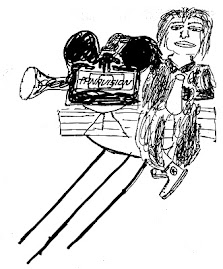
1985 fan art created by the author


(This essay was originally written for Night Flight Plus. It has been recreated in the style it was presented in at the site, and matched to its original date of publication. Tremendous thanks to Stuart Shapiro and Bryan Thomas for the platform.)

Wednesday, July 20, 2016

"Vyv! Eat the telly!"


A surrealistic, irreverent, and often violent exploration of four college students sharing a seedy house, “The Young Ones,” the first BBC series to debut on MTV, became a cult sensation that has kept its popularity for decades, gave audiences their first look at British comedians later to become worldwide stars, and predicted some of the shows that MTV made famous.


Much as stand-up comedy in America saw a sea change in style and attitude during the ’70s counterculture boom, England in the ‘80s was also in the midst of a shake-up in who would be creating comedy and how it would be done.


Oddly enough, both groups were getting noticed at clubs called The Comedy Store, though England’s had no connection to the famous Mitzi Shore-operated landmark aside from inspiration.


This new breed of British comedians were determined to stand out in direct, punkish contrast to both old traditionalist comedians, white males making cheap and often derogatory jokes about women and minorities, and newer comedians that had more progressive ideas, but were still from affluent backgrounds and thus having a certain detachment from the working class. These were educated but not posh individuals who wanted to shake up the audience, either through confrontational jokes or unconventional behavior.


Among the performers who earned a following from The Comedy Store were Rik Mayall and Adrian Edmondson, who performed unpredictable improv-style sketches under the name 20th Century Coyote, Nigel Planer and Peter Richardson, who did genre lampoons often featuring escalating comic violence as The Outer Limits, and the club’s house M.C., Alexei Sayle, who mixed physical gags with directly left-leaning political material.


Peter Richardson, Jennifer Saunders, Nigel Planer, Arnold Brown, Alexei Sayle, Rik Mayall, Dawn French, Ade Edmondson


These five performers, along with some other promising talents, ultimately decamped and created their own club in Soho, The Comic Strip. Their reputations grew even larger to the point where two TV networks eagerly sought them out to put them on the air.


Channel 4, not yet broadcasting, signed them to a series of six half-hour programs under the umbrella title “The Comic Strip Presents.” As this show was being assembled, the BBC, with producer Paul Jackson, also offered them a series, which would be ostensibly a conventional sitcom, peppered with all the comedians’ strengths, which became “The Young Ones.”


“The Comic Strip Presents” debuted on the night of Channel 4’s first broadcast, November 2, 1982, with “The Young Ones” launching on BBC2 a week later on November 9.


The concept of the show came from Rik Mayall, Lise Mayer — who was dating Mayall during production — and Ben Elton, a college friend later to embark on his own stand-up career. They figured that for a sitcom setting, the actors needed to be in the same room for long stretches of time to play off each other, and while they initially considered making the characters unemployed, thought that notion would be too political.


Instead, Mayall decided to flip the script, and make them college students, saying, “I wanted them to be privileged, and for people to hate them.”


Much of the show’s characters emerged out of existing material the actors had previously worked out on stage. Mayall had created a vain, pompous, and easily angered poet character in his act which evolved into Rick, the posturing political agitator with an incongruous love of Cliff Richard.


Similarly, Planer had been playing a dim, earnest hippie character in his act which became the base for Neil, the glum and easily dominated pacifist. Edmonson had frequently used over-the-top violence in his sketches with Mayall, which was channeled into punk rocker Vyvyan, whose solution to most issues with people and things was to batter them with heavy blunt objects. Sayle effectively served as a human non-sequitur, showing up in an episode, doing something odd, and then leaving the scene.


Mike, the smooth semi-straight man and official “Cool Person” of the house, was the only character that didn’t have an antecedent from the Comic Strip days. It was also the only character not portrayed by a Comic Strip alumnus. While intended for Planer’s partner Peter Richardson, Richardson clashed fiercely with BBC producer Paul Jackson and exited the series before filming, to be replaced by actor Christopher Ryan.


The Young Ones on location in Bristol, UK, August 1982, left to right: Chris Ryan (“Mike”), Rik Mayall (“Rick”), Nigel Planer (“Neil”) and Ade Edmondson (“Vyvyan”)


Together, this character group allowed Mayall and the writers to tweak the template of the traditional family sitcom. “If you look at ‘The Young Ones’, it was a nuclear family. Mike was the dad, Neil was the mum, Vyv was the little boy and Rick was the little girl, complete with pigtails.”


In order to obtain the extra budget they anticipated to include special effects, location shoots, and the other wild items that added to the show’s individuality, the creators decided each episode would feature a musical performance from a band, because this automatically changed the network’s classification of the program from “comedy” to “variety,” and thus allocated them more funds. The bands tended to be left alone to perform their songs, though occasionally they were integrated for humorous effect, as in the episode “Sick”, when Madness prematurely stopped singing “Our House” and fought amongst themselves.


The series quickly became a destination for other comedians, some friends of the show creators, others established elsewhere. Perhaps the most retroactively star-stuffed episode of the series was “Bambi”, which featured appearances by Mel Smith, Griff-Rhys Jones, Robbie Coltrane, Tony Robinson, Stephen Fry, Hugh Laurie, and Emma Thompson.


Since many of these performers had come from more affluent circumstances than the show regulars, the casting was fraught with some class tension, as Alexei Sayle recounted for The Guardian in 2013:


“I turned up for the recording to find several generations of Cambridge Footlights were in the show. ‘I thought these people were the enemy!’ I railed at the writers. ‘The whole point of what we were doing was surely to challenge the smug hegemony of the Oxford, Cambridge, [privileged]-schoolboy comedy network, as well as destroying the old-school working men’s club racists!’ ‘No, that was just you,’ the writers replied. ‘We never subscribed to your demented class-war ravings. We think all these people are lovely…Mel Smith’s going to take us for a ride in his gold Rolls-Royce, and Griff Rhys Jones has been screaming abuse at minions to make us laugh.'”


 The series ended for good after its second season in 1984.


Creator Mayall had observed, “If there were only twelve [episodes of] ‘Fawlty Towers’, why would I presume to do more?”


The cast had already moved on to other projects when MTV picked up the U.S. rights to the show and began airing it Sunday nights in June 1985.


Plenty of other British TV comedies had received exposure in America around that time, but most were relegated to selected PBS stations, and, aside from “Monty Python’s Flying Circus,” appealed to an older demographic.


Shows like “Are You Being Served,” and “The Good Life,” with their middle-aged casts and cutesy innuendos and general distance from everyday realities had little appeal to the rock ’n’ roll crowd.


“The Good Life” was directly slagged by Vyvyan in the “Sick” episode as he ranted, “I hate it! It’s so bloody nice! [Those characters are] nothing but a couple of reactionary stereotypes confirming the myth that everyone in Britain is a lovable middle-class eccentric!”


“The Young Ones” quickly became a U.S. hit. John Sykes, then-VP of programming for MTV, told Billboard magazine in November 1985, “Even though there are only fourteen episodes, we find viewers getting more and more excited about the show,” and also suggested the network would commission new episodes.


While that idea did not pan out, MTV later acquired U.S. rights to “The Comic Strip Presents” from Channel 4, and ran those episodes after “The Young Ones” for fans eager to see more of the cast’s work.


Planer’s put-upon hippie Neil became the favorite of U.K. and U.S. viewers alike. A tie-in book, Neil’s Book of the Dead, presenting his musings and poetry, was published in England in 1984.


A companion record followed, Neil’s Heavy Concept Album, featuring prog rock covers and sketches produced by Eurythmics’ Dave Stewart. Its first single, a cover of Traffic’s “Hole in My Shoe,” went to #2 on the UK Singles chart in July 1984.


In late 1985, based on the success of the MTV run, Book of the Dead received a U.S. release, and though the album did not, Planer appeared on MTV as Neil to do a Guest V.J. segment where “Hole in My Shoe” was aired; the video received repeat airings for a short time after.


Though a few years later “The Young Ones” would be gone from MTV, its impact upon the channel was large. Seeing that the music video crowd also craved comedy, MTV would add reruns of shows influential to “The Young Ones”: “Monty Python’s Flying Circus” and “The Monkees.”


Moreover, many of the original shows that MTV launched, as they began their move away from music video programming, can trace their roots to recurrent themes of “The Young Ones.” A house full of diverse individuals with caustic personalities that don’t get along? Here’s “The Real World”! Dim youth watching the telly and making rude observations? Hello “Beavis & Butthead”! Reckless guys subjecting each other to escalating pranks and grievous bodily harm? Welcome to “Jackass”! Self-centered narcissist with bad poetry demanding attention from people who don’t like them? Come to “My Super Sweet Sixteen.”


While allusions to other MTV hit shows may be stretching a point, it’s clear that “The Young Ones” tapped into many primal interests and instincts of a generation, and MTV noticed what those were and exploited them ingeniously.


It’s also notable that afterward, the next British sitcom to take America by storm would be “Absolutely Fabulous,” created by and starring Jennifer Saunders, who was also a member of The Comic Strip collective, a two-time guest star on “The Young Ones,” and since married to star Ade Edmondson. Saunders’ protagonist, Edina Monsoon, got her name by reworking his last name.


Though her husband had only minor impact on the series — singing its theme song, Bob Dylan’s “This Wheel’s On Fire,” and appearing in two episodes — much like his earlier show, “AbFab” also dispensed with the politesse of the stereotypical British comedy and ventured to outrageous, vulgar possibilities that appealed to younger viewers.  It too bypassed the traditional PBS route and debuted in the states on MTV’s sister channel Comedy Central.


“AbFab” also featured “Young Ones” alumnus Christopher Ryan in a recurring role as Edina’s first husband, Marshall.


All of the stars of “The Young Ones” continued to create more TV series and other works that fans should definitely seek out. And chances are still very good if you are at a party and happen to reply to someone by saying, “Don’t be all heavy and uncool man,” or snapping, “Well LA-DI-DAH, Neil!” there’s an excellent chance you’ll have a bonding opportunity with a fellow ‘80’s malcontent.


It’s clear that “The Young Ones” mayhem will be enjoyed by young ones for years to come.


(This essay was originally written for Night Flight Plus. It has been recreated in the style it was presented in at the site, and matched to its original date of publication. Tremendous thanks to Stuart Shapiro and Bryan Thomas for the platform.)